When businesses invest in new lighting, the first thing they often consider is the purchase price. That makes sense—but that one cost is just the tip of the iceberg. To fully understand the financial and sustainable value of a lighting solution, you have to look beyond the initial investment.
The Total Cost of Ownership (TCO) offers a broader perspective: it takes into account the purchase price, but also factors in maintenance, energy consumption, lifespan, and potential savings. This blog explains how TCO works in the context of lighting—and why it should play a central role in every lighting upgrade.

What is TCO and why does it matter?
TCO stands for Total Cost of Ownership. It’s a method for evaluating a product or system based on its full lifecycle cost, not just the upfront investment. Instead of asking, “What does this cost me today?” you ask, “What will this cost me—and deliver—over its entire lifetime?”
A good analogy is the difference between buying an electric vehicle (EV) and a combustion-engine car: while the EV typically requires a higher initial investment, it pays off over time through lower fuel and maintenance costs. Its total cost over its lifetime is often lower—and that’s exactly what TCO aims to capture.
In lighting, this means looking at more than just the price of fixtures and installation. You also have to consider:
- Energy consumption
- Maintenance and repair costs
- Expected lifespan
- Impact on user comfort and usability within your building
This is important because lighting is rarely a one-off cost. A solution that looks cheap today can turn out to be expensive over time due to high energy bills, frequent replacements, or complicated maintenance. On the other hand, investing in high-quality, energy-efficient, and intelligently controlled lighting can pay for itself—and keep delivering long-term value.
TCO helps you make better decisions: not just what’s cheapest on paper, but what delivers real return in practice.
The Three Main Cost Drivers: CAPEX, OPEX, and Energy
When assessing lighting through the TCO lens, three key cost drivers come into play:
- Investment (CAPEX): The upfront cost of the project: fixtures, installation, cabling, control systems, and possible integrations. It’s often the only element organizations focus on—but it’s just one piece of the puzzle.
- Maintenance and Replacement (OPEX): How long do the fixtures last? How often do they need to be replaced? How easy are they to maintain? Lower-cost systems may seem attractive initially, but ongoing technical interventions can quickly drive up total costs.
- Energy Consumption: Arguably the biggest long-term factor. Energy-inefficient lighting can eat into your operating budget year after year. This is where LED technology and smart controls make a massive difference—not just reducing usage, but ensuring light only burns where and when it’s needed.
Smart investment: When higher CAPEX means lower OPEX
A common instinct when selecting a lighting system is to choose the lowest upfront price. But focusing only on CAPEX ignores the bigger picture.
Seemingly inexpensive systems often lead to higher operational costs because:
- They consume more energy
- They have shorter lifespans
- They require more frequent maintenance or replacement
- They lack smart features that help reduce energy use
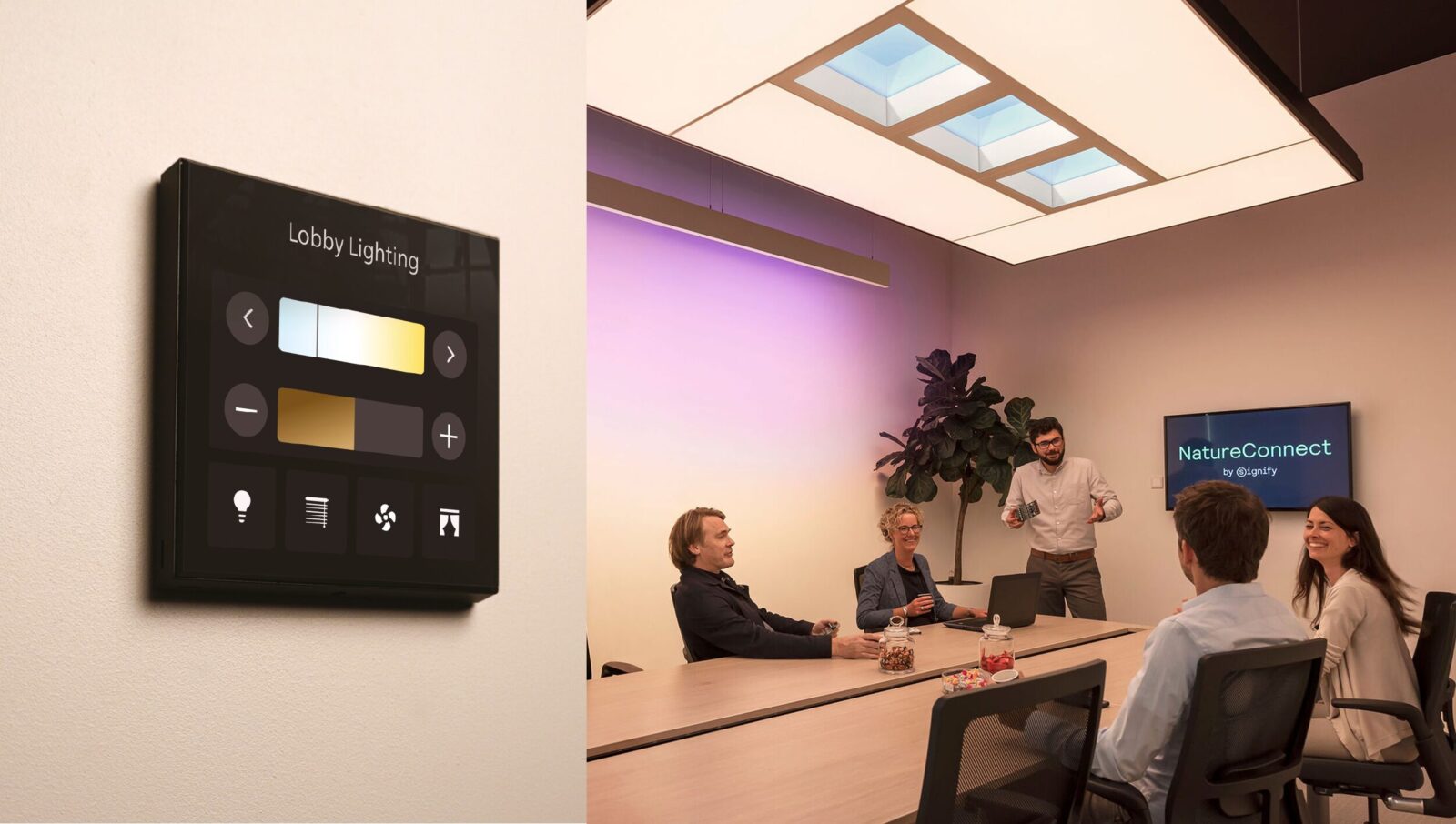
The smarter approach is to invest in high-quality LED lighting, paired with an intelligent control system like Casambi or Interact. These systems not only reduce energy consumption significantly – they also lower maintenance needs and dramatically improve the user experience.

In the above visual we often use to illustrate this concept, current energy costs are the starting point. After implementing a new lighting solution, those costs drop sharply. The difference is used to pay off the installation during the contract period. Once that’s complete, the only thing left is reduced energy costs—and growing savings, especially as energy prices rise.
This approach proves that even with a higher upfront investment, the payback period is often surprisingly short. And the long-term impact? Structural and sustainable.
Smart control: a key TCO accelerator
Efficient lighting fixtures are the foundation of a sustainable lighting solution – but it’s smart control that unlocks the full potential of your investment.
Unlike traditional on/off lighting, smart lighting gives you granular control tailored to how your building is actually used.
How smart control lowers TCO:
- Occupancy sensors prevent lighting empty spaces unnecessarily
- Daylight sensors reduce artificial light usage when natural light is available
- Time-based scenarios automatically lower lighting levels outside of peak hours
- Zone-based control ensures only active areas are illuminated
- Central dashboards and mobile apps offer real-time insight and remote adjustments
These features enable continuous optimization and help avoid waste. That translates into lower energy bills, less wear on fixtures, and smarter building management overall.
The result? A system that lasts longer, pays for itself faster, and delivers a significantly lower Total Cost of Ownership.
Added value: comfort, sustainability and compliance
TCO is not just about financial numbers. A smart, forward-thinking lighting system offers tangible benefits for people, the planet, and regulatory compliance. In that sense, lighting is not just a cost – but a strategic asset.

Sustainability
Reducing energy use directly lowers your building’s carbon footprint. That helps meet internal climate goals and supports certifications like BREEAM, WELL, or ISO 50001.
User comfort and wellbeing
Properly tuned lighting improves comfort, safety, and overall experience for building occupants. In schools, offices, healthcare or sports settings, this leads to greater satisfaction, better performance, and fewer complaints.
Regulatory readiness
New EU regulations such as EPBD IV require smart lighting with energy and CO₂ reporting in large buildings. Investing now in a future-proof solution means you avoid fines and complex retrofits down the line.
Conclusion: smart lighting = long-term value
The Total Cost of Ownership (TCO) of lighting clearly shows that energy usage is by far the largest cost over the life of a system. A “cheap” purchase today can be much more expensive in the long run compared to a well-planned, energy-efficient solution.

By looking beyond upfront costs and focusing on the full picture, organizations make a sustainable choice that pays off across the board:
- Financial: Lower operational costs through energy and maintenance savings
- Environmental: Less energy = less CO₂
- Operational: More comfort, safety, and smarter control
- Strategic: Compliance with regulations, sustainability goals, and ESG standards
At Project Nekton, we help you navigate this transition. We collaborate with you to find the optimal balance between investment, performance, and long-term value – tailored to your building, users, and ambitions.
Finally, we’d like to highlight a few cases where our use of smart lighting control significantly reduced the Total Cost of Ownership: